Cognitive Load Theory in Medical Education
Cognitive overload may be a familiar feeling for those on a busy clinical team: a learner toggles between the medical record, phone calls and a differential diagnosis while the attending physician asks for the next steps for a patient’s care. The learner possesses the knowledge to complete all these tasks, but finding and applying that knowledge under pressure can sometimes feel impossible. Cognitive load theory (CLT) can help explain why.
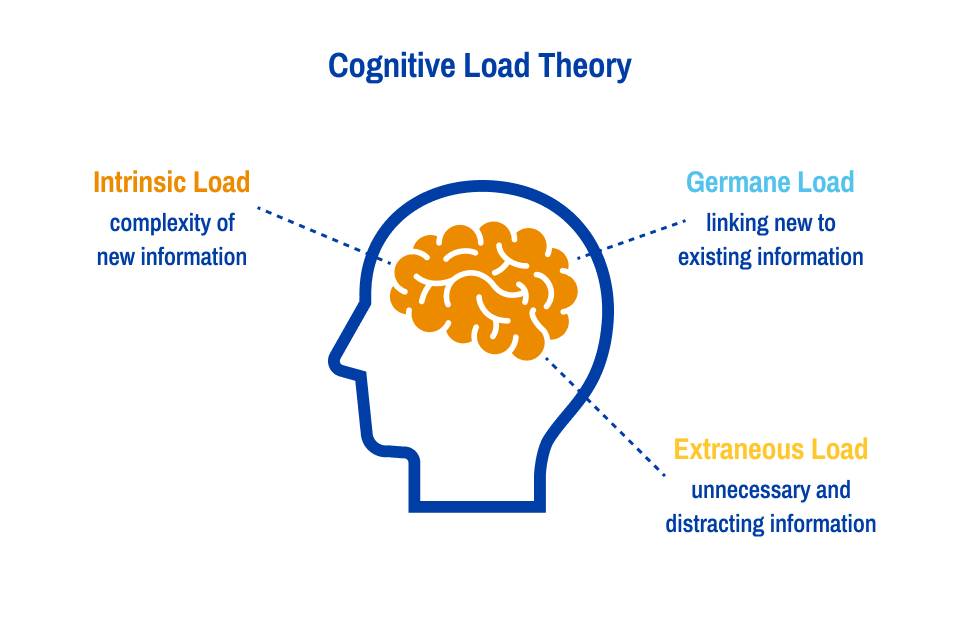
With accelerating complex patient care due to advances in medicine, increasing documentation burden and intensified multitasking due to staffing shortages, cognitive demands in the clinical environment can be amplified. When cognitive demand exceeds the brain’s limited working memory, performance can suffer. This is not because the learner lacks motivation or ability, but rather because the information and tasks are disorganized and difficult to process efficiently. Research on CLT underpins this perspective and offers practical guidance for teachers and learners that experience cognitive overload. CLT is divided into three types of mental effort that competes for cognitive resources: intrinsic load, extraneous load and germane load.
Intrinsic Load
Intrinsic load is the inherent complexity of what is learned or completed. Ineffective training or instruction such as teaching complex subject matter beyond the learner’s expected level can increase the intrinsic load. Prior studies have shown that scaffolding and sequencing are two methods to decrease intrinsic load. Scaffolding includes providing temporary, tailored support to the learner while they are learning new skills. Sequencing is a tool during the scaffolding process that involves teaching material in a logical order.
Extraneous Load
Extraneous load is the avoidable burden imposed by how information is presented. Ineffective training and instruction can increase extraneous load for the learner with inadequately designed materials, distracting environments, unclear instruction and multitasking. Common strategies to manage extraneous load include simplifying information, creating consistent designs, reducing distractions and removing irrelevant details. This can help prevent the learner’s brain from doing unnecessary work.
Germane Load
Germane load is the productive effort invested in forming and refining schemas. Schemas are mental structures that help learners understand how things work by using past knowledge, incorporating new ideas and developing a deeper understanding of the content. Effective teaching and instruction can help maximize germane load during the learning process. Germane load is burdensome when intrinsic load and extraneous load are excessive, and it is strengthened when instruction begins with support to learners such as worked examples or spaced repetition to consolidate learning schemas.
In medical education, aligning teaching with CLT can support better learning. Clear materials and thoughtful scaffolding of knowledge support novice learners to reach proficiency faster, commit fewer errors and transfer approaches more reliably to subsequent patient encounters via retrieval practice. Educators can benefit from reusable templates, visuals, case cards or cue sheets that make preparation for education more efficient and instruction more consistent across all settings. A common teaching method used by educators in the clinical setting is “chalk talks” that manage cognitive load with pacing control, focused content discussion and explicit demonstration.
When used within institutional guidelines, artificial intelligence (AI) has the potential to further support CLT by reducing avoidable learning loads and personalizing the learning process. AI can be used to act as a tutor for learners by distilling complex concepts to simple learning tasks, automating spaced repetition and annotating visuals, all of which can optimize learning for the individual to reduce intrinsic and extraneous load and strengthen germane load. AI can also help educators develop multimedia learning frameworks to enhance educational experiences for learners.
CLT describes why cognitive overload can occur in high-stakes learning and offers the educator and the learner the opportunity to reflect upon how to best optimize intrinsic load, extraneous load and germane load. If done so effectively, learners’ performance and information retention can be improved and amplified with AI-driven tools while educators also strive to create learning environments that reduce extraneous load and increase germane load.
 Josh Samec, M.D., is a fellow in the SSM Health/Saint Louis University School of Medicine
Rheumatology Fellowship Program. Josh’s areas of professional interest include patient
advocacy and medical education. Josh can be contacted via email.
Josh Samec, M.D., is a fellow in the SSM Health/Saint Louis University School of Medicine
Rheumatology Fellowship Program. Josh’s areas of professional interest include patient
advocacy and medical education. Josh can be contacted via email.